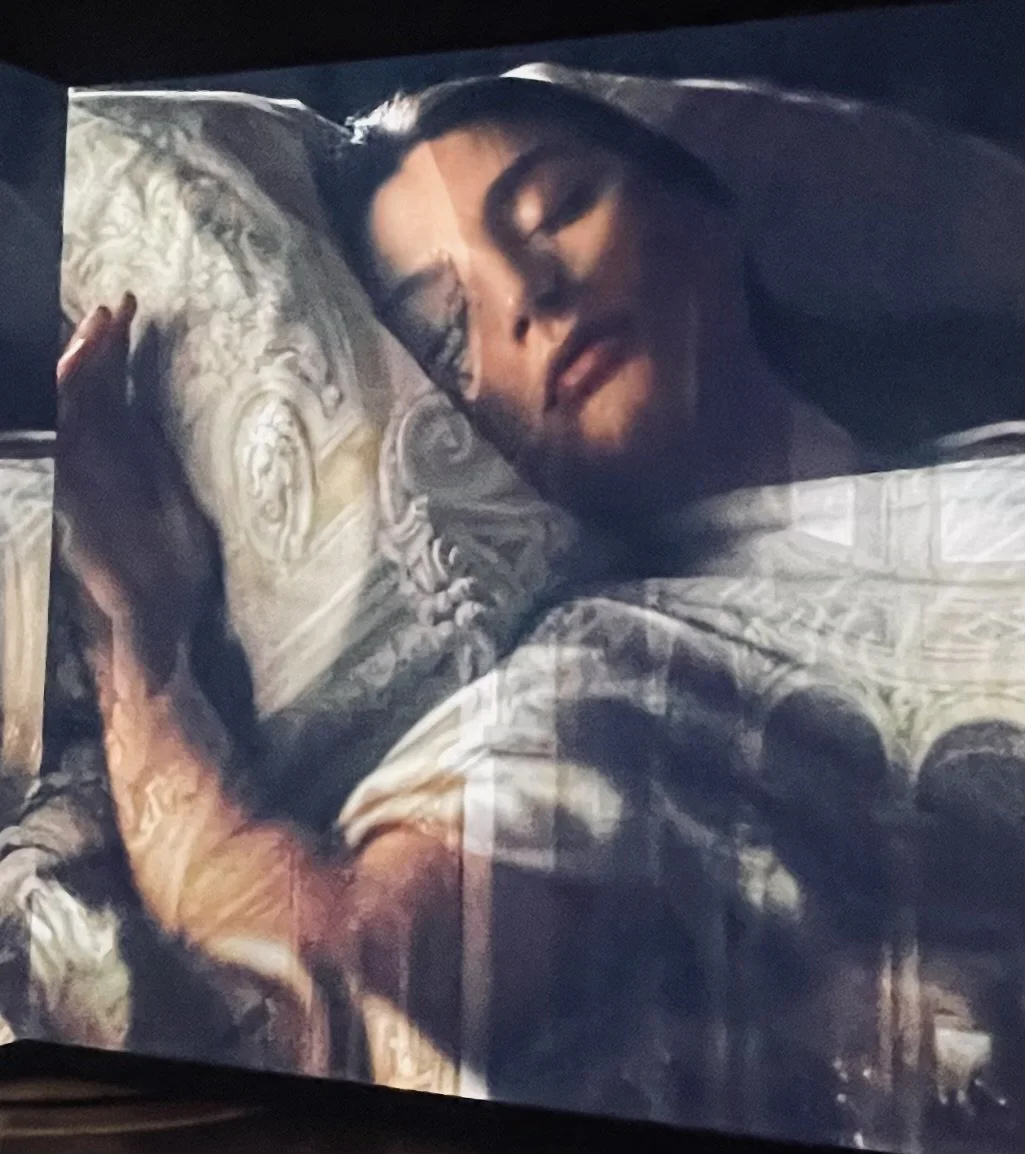
Imprints & Pathways - part VI
My dreams contain my days.
My days learn to see them.
Sample of the poem Living Bridge by Sophie Roumeas (April 2026)
Illustration from the animated teaser of Museum Poldi Pezzoli, Milan, Italy.
Imprints & Pathways Series
A series of poems, Imprints & Pathways.
Part VI, Living Bridge : A poetic journey through Italy and inner landscapes, where dreams, places, and lived experience intertwine.
Explore how memory, perception, and emotion shape a living bridge between the visible and the unseen.
A shorter version has been shared on my Instagram @travelmelikepoetry.
Imprints & Pathways
(Poems about awakening within)
By Sophie Rouméas
VI Living Bridge
(Imprints of Italy and Soul)
On the forecourt of the Cathedral of Milan…
Passing through this vibrant city, along the path of our journey in Italy.
Three dreams emerge—
pathways of connection,
linking my psyche to the coming day.
Courmayeur.
Before falling asleep, in this mountain town cradled by the high peaks of the Mont Blanc range,
I attune myself to this raw, majestic, untamed nature.
Tuesday morning.
I gather fragments of dreams that drift away faster than white ribbons in a wind-swept sky.
An echo of a voice returns, then a gesture revealed in filigree:
to follow the instinctive trace of a stone.
The voice in the dream told me
that one can place a hand upon a stone
and follow a path invisible to the eyes,
yet visible to the initiated heart.
Bathed in a quiet sense of gratitude,
without fully grasping its meaning,
I move through the day simply.
At breakfast, I decide to walk toward a small healing chapel
at the top of the village, at the foot of the mountains.
We walk there slowly,
and upon arrival I feel a strange impression—
as though the place had been waiting for me.
I offer water from my bottle to the flowers beside the chapel,
as the Virgin Mary invites pilgrims
to honor those before her behind the glass.
I lay down prayers of healing
for all those I love.
Then my gaze turns
to a grey triangular stone to the right of the chapel—
and there, my dream appears upon the stone:
a shimmering white path,
drawn by nature itself,
a mineral filigree
such as crystal hunters might discover
when breaking open rock.
Wednesday noon.
We sit on the terrace of a restaurant near the Duomo di Milano.
We have just visited the cathedral—
immense, moving,
shaped over six centuries
to become the second largest Catholic edifice in the world.
We walked upon its roof for an hour,
suspended between sky and spires,
gargoyles, saints, and angels…
Then descended into the nave and choir,
where my breath faltered
and my eyes filled with tears
before the devotion held within those sacred walls.
As we revisit this overwhelming experience,
suddenly all conversations fall silent—
ours, and those around us.
Passersby hold their breath.
We all turn toward a cry—
piercing,
human, yet almost inhuman
in its distortion of pain.
The sound lingers in our ears.
We look at one another.
Tourists who witnessed the scene tell us
the police are restraining someone
a few dozen meters away.
We will not see their face.
We will not know why.
A cry without a face.
A cry without explanation.
A cry that continues to resonate
long after it has ceased.
And then, a fragment of the previous night returns—
a nightmare this time.
I am watching a disturbing scene:
a man with malicious intent prepares a powerful potion
for another who will unknowingly consume it.
The scene unfolds inside a glass block.
I remain outside.
The one who drinks becomes violently ill.
Those around him see and are afraid—
his eyes bloodshot,
his jaw damaged…
Then I enter the glass enclosure
to take him in my arms.
I see his face as well—
but there is no sound.
The exact inversion of the day:
a cry without a face,
and in my dream,
a face without a cry.
Thursday afternoon.
A cooler day in Milan.
We take photographs in the artistic district of Brera,
marveling at a façade
where shadow and light intertwine,
breathing in the fragrances of elegant boutiques,
taking in the countless colors
of passersby who, like us, wander through the streets
carried by the wind.
After a light lunch,
we walk toward the museum
where we are to encounter
some of the greatest works
of the polymath Leonardo da Vinci.
This brilliant mind—
prolific in engineering, painting, and music—
creator of The Last Supper,
of countless masterpieces,
of early flying machines,
of mechanisms, lions, and visionary forms—
has offered, and continues to offer,
proof that the human mind
is capable of creativity
far beyond what we imagine possible.
How else could a single man
have been the origin
of a vast codex of nearly 40,000 pages of innovation,
and paintings that continue
to captivate the world?
I walk toward a painting—
Lady with an Ermine.
A symbol of love and attachment.
Through my headphones,
I listen to explanations of its composition,
the techniques Leonardo employed
to bring such subtle movement to life…
The ermine…
Suddenly, flashes of dreams from the past two nights return:
ermines moving through nature,
one appearing in the same field of vision as my companion,
a meadow-like presence,
a living tableau from the night before…
My dreams contain my days.